

If you're launching or scaling a telehealth brand, you've probably framed the platform decision as a binary: buy an all-in-one suite or build custom from scratch. One gives you speed. The other gives you control. And the assumption is that you have to pick a side.
That framing is wrong. Not because those options don't exist, but because there's a third path that most teams overlook. And once you understand it, the decision becomes a lot clearer.
This post breaks down the structural tradeoffs between all-in-one platforms, fully custom builds, and modular infrastructure. We'll keep it practical: what each approach actually looks like in operation, where the pain shows up, and what questions you should be asking before you commit.
The All-in-One Telehealth Platform Trap
All-in-one telehealth platforms are genuinely appealing at first glance. One vendor, one contract, one login. They handle your checkout, your patient portal, your provider network, your pharmacy routing, and your marketing site. You sign up and things work. The demo looks clean. The sales team is responsive. Launch timelines are measured in weeks.
The problems start showing up about 90 days in.
All-in-one platforms optimize for the average case. They build features that work for the widest set of customers, which means every piece of the platform reflects compromises you didn't choose. The checkout flow is fine, but you can't customize the intake logic without filing a feature request. The provider network works, but it's their network, with their credentialing process and their availability rules. The patient portal exists, but it doesn't connect to the CRM you already use.
This matters more than most teams realize upfront. Your telehealth operation isn't static. You'll want to add new treatment categories, change pharmacy partners, adjust intake flows based on conversion data, or switch to a provider network that better fits your clinical model. On an all-in-one platform, each of those changes is either impossible, expensive, or dependent on someone else's prioritization.
Where Lock-in Gets Real
- Provider networks: You're limited to whoever the platform contracts with. If you find a better partner for your niche, switching often means switching platforms entirely.
- Checkout and intake: Conversion optimization requires iteration. If you can't modify your checkout flow without a dev ticket to the platform vendor, you're iterating at their pace, not yours.
- Pharmacy routing: Different treatment categories often need different pharmacy partners. All-in-one platforms typically support their preferred partners, not yours.
- Data and integrations: Your patient data lives in their system. Getting it out, or connecting it to your own analytics and CRM tools, ranges from awkward to adversarial.
- Marketing site: Template-based sites get you live fast but limit your ability to differentiate. Performance tuning and SEO work are constrained by whatever the platform supports.
None of these are dealbreakers on day one. They're dealbreakers on day 180, when you've built your operation around the platform and the switching cost is enormous.
What Does Building Custom Telehealth Infrastructure Actually Cost?
So if all-in-one platforms constrain you, why not just build everything yourself? You'll have total control. Every integration is exactly what you need. Your checkout flow is purpose-built. Your data architecture is clean from the start.
Here's the reality: custom builds take 6 to 12 months to reach production. They require a full engineering team, a dedicated product manager, and enough capital to fund development before you've generated meaningful revenue. Every API integration is its own project. Every compliance requirement is your responsibility to research and implement. Every edge case in pharmacy routing or provider scheduling is yours to discover and solve.
// PULLQUOTEThe custom build isn't a platform decision. It's a company-building decision. You're choosing to become a software company that also does telehealth.
For well-funded teams with strong technical leadership, this can work. But for most telehealth brands, especially those trying to validate a market or scale efficiently, the custom build is a trap of a different kind. You spend your first year building infrastructure instead of acquiring patients and iterating on the clinical experience.
The Hidden Costs of Custom
- Timeline: Six to twelve months before launch is common. In telehealth, that's an eternity of missed market signal.
- Hiring: You need backend engineers, frontend engineers, a DevOps resource, and someone who understands healthcare compliance. That's a minimum team of four to six before you've seen a single patient.
- Maintenance: Once built, custom systems need ongoing maintenance. API partners change their specs. Compliance requirements evolve. Every integration is a surface area for bugs.
- Opportunity cost: Every engineering hour spent on checkout infrastructure is an hour not spent on the clinical product, the patient experience, or growth.
Custom builds give you control, but they charge you for it in time, money, and focus. Most teams underestimate all three.
The Third Path: Modular Infrastructure
There's an approach that doesn't get enough attention: modular, productized infrastructure. Instead of buying a monolithic suite or building everything from zero, you use purpose-built modules that handle specific parts of the telehealth stack. Each module works independently. Together, they form a complete platform. But critically, they don't lock you in.
This is what we've built at Thimble Hub. Three products, each designed to own a specific layer of your telehealth operation, each designed to work with whatever other tools you're already using.
What Modular Looks Like in Practice
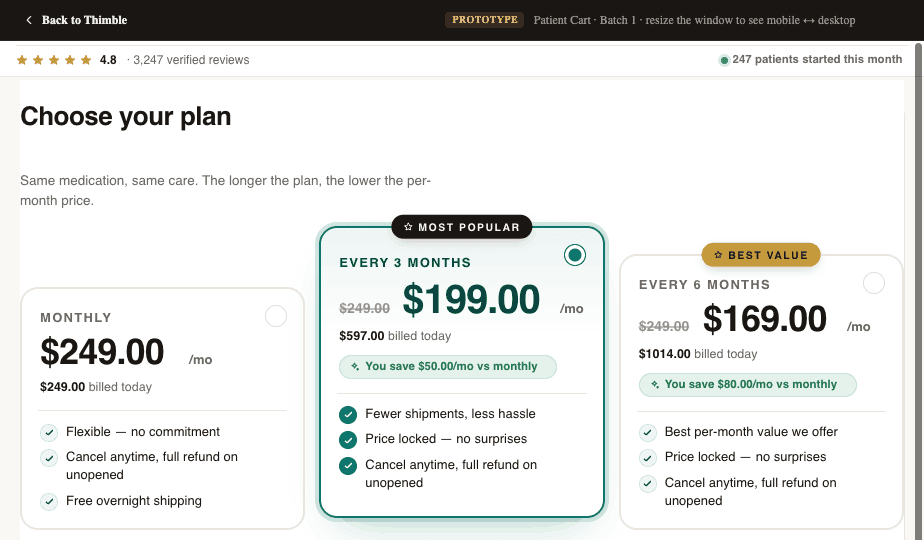
Thimble Cart handles checkout and intake automation. It works with any provider network, any pharmacy, and any form builder. You control the flow. You control the logic. You're not locked into someone else's intake opinions.
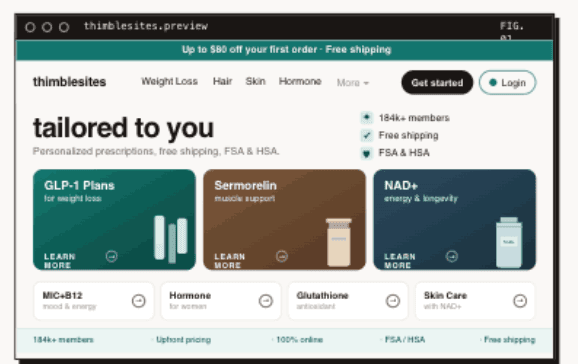
Thimble Sites gives you a custom marketing website built for telehealth. Not a template with your logo dropped in, but an actual performant site. We're talking 90+ Lighthouse scores, real SEO foundations, and full design control. It's your brand, not a branded version of someone else's template.
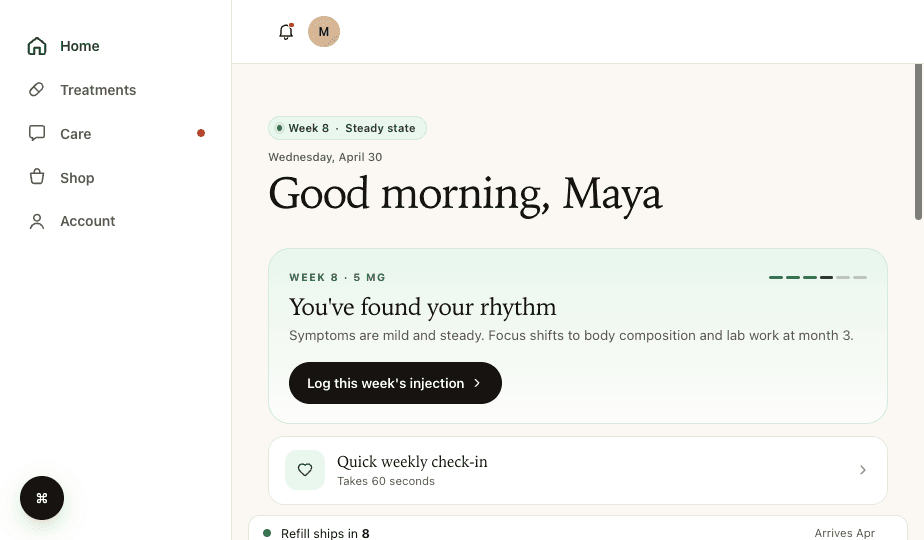
Thimble Portal is the patient experience layer. It connects to any EHR, any CRM, and any internal system you're running. Your patients see a cohesive experience. Your ops team works in the tools they already know.
You can use one module or all three. Start with Cart to launch your checkout in days, add Sites when you're ready to invest in acquisition, bring in Portal when your patient volume demands a better experience layer. Or start with all three and be live in under 12 days.
The key difference from an all-in-one platform: if something isn't working, you replace that piece. You don't blow up your whole stack. And the key difference from a custom build: you're not spending six months and six figures on infrastructure before seeing your first patient.
What to Actually Evaluate
Whether you're comparing all-in-one platforms, custom builds, or modular approaches, the important questions are the same. Most teams don't ask them until it's too late.
Provider Network Flexibility
Can you change provider networks without rebuilding your platform? This is one of the highest-impact decisions in telehealth, and it changes as your business evolves. If your platform dictates who you can work with, your clinical model is constrained by a software decision.
Checkout and Intake Iteration Speed
Your checkout flow directly impacts revenue. Can you test a new intake question, change your pricing display, or adjust the order of steps without filing a ticket and waiting two weeks? If not, your conversion optimization happens at your vendor's pace. In a competitive market, that's a real disadvantage.
Data Routing and Ownership
Does your patient data route cleanly to the systems where you actually operate? If you use a specific CRM or EHR, does the platform support native integration, or are you exporting CSVs? Data that flows cleanly means less manual work, fewer errors, and faster operations. Data that's trapped in a vendor's system means you're always working around limitations.
How Fast Can You Launch on Each Platform Type?
Can you launch in weeks, or are you looking at quarters? Time to market matters, not just for revenue, but for learning. Every week you're not live is a week you're not collecting real patient feedback, real conversion data, and real operational insight. The best infrastructure gets you live fast and lets you iterate from there.
What Happens When You Need to Change Something?
This is the question most teams forget to ask. What happens if you need to change something in six months? Not the whole platform, just one piece. A new pharmacy partner. A different form builder. A CRM migration. If changing one component requires rebuilding three others, your architecture is working against you.
- 01.Can I switch provider networks without a platform migration?
- 02.Can I iterate on checkout and intake without engineering resources?
- 03.Does patient data flow into the systems my team actually uses?
- 04.Can I be live and seeing patients within two to three weeks?
- 05.If I need to replace one tool, does everything else keep working?
How the Three Approaches Compare
Let's put the three options side by side on the dimensions that actually matter in day-to-day telehealth operations.
Speed to Launch
All-in-one platforms are fast, typically two to six weeks. Custom builds are slow, six to twelve months. Modular infrastructure splits the difference by giving you productized tools that are ready to deploy. At Thimble Hub, most teams launch in under 12 days. That's not a stripped-down MVP; it's a complete checkout, site, and portal.
Flexibility Over Time
All-in-one platforms start rigid and stay rigid. Your flexibility is limited to what the vendor builds. Custom is flexible by definition but expensive to change because every modification is an engineering project. Modular infrastructure gives you flexibility by design. Swap a pharmacy partner, change your form builder, connect a new CRM. The modules are built to work with your tools, not replace them.
Cost Structure
All-in-one platforms have predictable monthly costs, but they often include fees for features you don't use and surcharges when you scale. Custom builds have high upfront costs and ongoing maintenance expenses that are hard to predict. Modular infrastructure lets you pay for what you use. Need only a checkout solution? Use Cart. Ready for the full stack? Add Sites and Portal. Your costs scale with your actual needs.
Support and Partnership
This one is underrated. Large all-in-one platforms treat you like a ticket number. Custom builds mean your support is whatever you can hire. Boutique modular providers, and this is where we think Thimble Hub genuinely stands apart, actually work with you to succeed. We're small enough to care about each customer and experienced enough to have seen the problems before.
Choosing Infrastructure That Works for You
The platform decision isn't really about which approach is objectively best. It's about which approach is best for where you are right now and where you're headed next.
If you're a funded startup with a dedicated engineering team and 12 months of runway before you need revenue, a custom build gives you maximum control. Just go in with your eyes open about what it costs in time and focus.
If you need to be live next week and you're okay trading flexibility for speed, an all-in-one platform will get you there. Just understand that you're inheriting constraints that compound over time.
If you want to launch quickly, keep control over the parts of the stack that matter most, and retain the ability to change direction without a migration project, modular infrastructure is the approach worth evaluating seriously.
We built Thimble Hub because we saw too many telehealth teams stuck in that false binary, choosing between platforms that locked them in and custom builds that drained their resources. There's a better way to build, and it starts with infrastructure that adapts to your business instead of the other way around.
If you're evaluating your telehealth stack, whether you're starting from zero or rethinking what you've got, we're happy to talk through it. No pitch, just an honest look at what makes sense for your situation.
Frequently Asked Questions
- What is modular telehealth infrastructure?
- Modular telehealth infrastructure means building your telehealth operation from purpose-built components that each own a specific layer of the stack: your checkout and intake, your patient portal, your marketing site, your EHR, your pharmacy routing. Instead of buying a single all-in-one platform that handles all of these together (and ties them together in ways that are hard to change), or building everything from scratch using custom engineering, you use productized modules that are designed to work independently and connect cleanly to each other. The result is that you can replace any single piece without rebuilding the whole system, and you're not locked into any single vendor's roadmap for every layer of your operation.
- Is modular telehealth more expensive than all-in-one?
- Not necessarily, and when you account for the full picture, modular infrastructure often costs less over time. All-in-one platforms have predictable monthly fees, but those fees frequently include features you don't use, per-patient or per-transaction markups that compound as you scale, and expensive lock-in that shows up as migration costs when you eventually need to change. Modular infrastructure lets you pay for what you actually use. If you only need a checkout solution right now, you use that. If you need the full stack, you adopt all three layers. There is no cost for seats or modules sitting idle. The more honest comparison is total cost of ownership over two to three years, including the engineering time you'd otherwise spend on workarounds, the revenue lost to a checkout that can't be optimized, and the cost of eventual migration off a platform that stopped serving you.
- How long does it take to launch on modular infrastructure?
- With Thimble Hub, most teams go from kickoff to live in under 12 days for the full stack: Thimble Cart, Thimble Sites, and Thimble Portal. Individual modules can launch faster. This is possible because modular infrastructure is productized rather than built from scratch. The integrations are pre-built. The compliance scaffolding is already in place. The design frameworks are ready to be customized rather than created from zero. Compare that to a custom build, which typically takes six to twelve months, or an all-in-one platform migration, which requires mapping and migrating all your existing data into a new system before you can go live.
- Can I keep my existing EHR with a modular approach?
- Yes. This is one of the core advantages of modular infrastructure over all-in-one platforms. Thimble Portal, for example, is designed to work alongside your existing EHR and CRM rather than replace them. Your clinical data stays in the systems your providers already know. Your operational team keeps their workflows. The modular layer handles the patient-facing experience and routes data to your existing tools through documented integrations. You are not asked to migrate your medical records or retrain your clinical team on a new system in order to improve your patient portal or checkout flow.
- What are the risks of all-in-one telehealth platforms?
- The biggest risk is lock-in that compounds over time. On day one, an all-in-one platform feels like a safe choice: one vendor, one contract, one set of integrations to manage. By month six, the constraints start showing up. You want to change your pharmacy partner and the platform only supports two. You want to test a new checkout flow and it requires a feature request with a six-week timeline. You want to connect your CRM and the API is limited or non-existent. You want to switch, and you discover your patient data is in a format that's expensive to migrate. The second risk is roadmap dependency: you are building your telehealth operation on someone else's product priorities. If the vendor deprioritizes a feature you need, or raises prices, or gets acquired, you have limited recourse because your entire operation is entangled with their system.
Building a telehealth brand?
Thimble Hub gives you the checkout, intake, patient portal, and EHR-routing infrastructure so you can launch in weeks, not quarters. Modular, HIPAA-ready, no lock-in.