

DTC men's health is a large and growing market. Hims alone generates $1.5 billion in annual revenue (FY2024). Ro, BlueChew, Keeps, and dozens of smaller brands serve millions of men who prefer the convenience and privacy of getting ED medication, hair loss treatment, and testosterone therapy delivered to their door.
What most people don't realize is that the underlying infrastructure for all of these companies is functionally identical. Patient fills out a questionnaire. Provider reviews it. Prescription gets routed to a pharmacy. Medication gets shipped. Subscription renews. The medications change between sildenafil, finasteride, and testosterone. The pipeline does not.
You can launch a branded men's health company on that same pipeline today, without raising venture capital, without hiring engineers, and without the 12-18 month build time that Hims invested before seeing its first patient. Here's exactly how.
The Men's Health Market in 2026
Erectile Dysfunction: The DTC ED Brand Opportunity
The US DTC ED telehealth market is a multi-billion dollar segment. Generic sildenafil and tadalafil are cheap to produce and not controlled substances, making them straightforward for telehealth prescribing. Compounding pharmacies create differentiated formulations (chewable tablets, sublingual troches, combination products) that let brands offer something generic retailers cannot.
Typical DTC subscription pricing: $15-90/month depending on formulation and quantity. Customer acquisition costs run $200-300+ in competitive advertising channels. The brands that win compete on experience, trust, and convenience rather than price.
Hair Loss: Building a DTC Hair Loss Brand
A $1.8-2.5 billion DTC market growing at 6-8% annually. Finasteride (1mg daily) is the standard prescription, with oral minoxidil (2.5-5mg, off-label) exploding in popularity since 2023 with prescriptions growing sharply year over year. Compounded topicals (finasteride + minoxidil + tretinoin combinations) are the premium product category.
Hair loss has the best retention of any men's health subcategory. Results take 6-12 months to show, but patients who stay through that window tend to subscribe for years. Average subscription: $20-75/month depending on whether it's oral generics or compounded topicals.
Testosterone Replacement Therapy
The US TRT market is a large and growing category. This is the most complex men's health subcategory because testosterone is a DEA Schedule III controlled substance. The DEA's Fourth Temporary Extension (effective January 1, 2026 through December 31, 2026) continues COVID-era telehealth flexibilities for Schedule II-V prescribing. The proposed permanent rule (NPRM published January 17, 2025) has not been finalized.
TRT requires lab work (total/free testosterone, CBC, PSA, metabolic panel) before prescribing and during monitoring. Typical DTC TRT subscription: $99-199/month including testosterone cypionate injections, supplies, and telehealth follow-ups.
What You Need to Launch
- 01.A clinical protocol: Work with a medical director to create prescribing guidelines for each product. This defines who qualifies, what gets prescribed, contraindications, monitoring requirements, and follow-up cadence.
- 02.A provider network: Licensed prescribers in your target states. You can build your own clinical team or use an integrated network (Wizlo, OpenLoop, MDI, CareValidate). Start with 5-10 states and expand.
- 03.Pharmacy relationships: A compounding pharmacy (503A or 503B) for custom formulations (chewable ED tabs, compounded topicals). A retail pharmacy partner for generic medications. The infrastructure handles routing automatically.
- 04.Prescription commerce infrastructure: The platform that connects intake, provider, pharmacy, billing, portal, and refill automation. This is what Thimble Portal provides.
- 05.Your brand: Name, positioning, visual identity, voice. This is where you differentiate. The infrastructure is identical. The brand is what patients choose.
The Regulatory Landscape You Need to Understand
- ED medications (sildenafil, tadalafil): Not controlled substances. Prescribable via asynchronous telehealth in most states. Minimal regulatory complexity. The Ryan Haight Act does not apply to non-controlled substances.
- Finasteride and oral minoxidil: Not controlled. Finasteride is FDA-approved for hair loss. Oral minoxidil is off-label (FDA-approved for hypertension only). Off-label prescribing is legal and common, but you cannot market oral minoxidil specifically as a hair loss treatment in advertising.
- Compounded formulations: Must come from a licensed 503A (patient-specific) or 503B (outsourcing facility) pharmacy. The FDA has increased scrutiny of compounding since the GLP-1 crackdowns of 2024-2025. Ensure your pharmacy partners are compliant.
- Testosterone: Schedule III controlled substance. Current DEA telehealth flexibilities (through December 31, 2026) allow Schedule III prescribing via synchronous video consultation (not async). A permanent DEA rule has been proposed but not finalized. State-by-state rules vary. Lab work required. This is the highest-complexity men's health product.
- State telehealth prescribing: Most states allow prescribing ED meds and hair loss treatments via asynchronous telehealth. Some states (TX, LA) have periodically pushed for synchronous requirements. Your infrastructure should handle state-by-state compliance automatically.
How the DTC Men's Health Brand Pipeline Works on White Label Telehealth
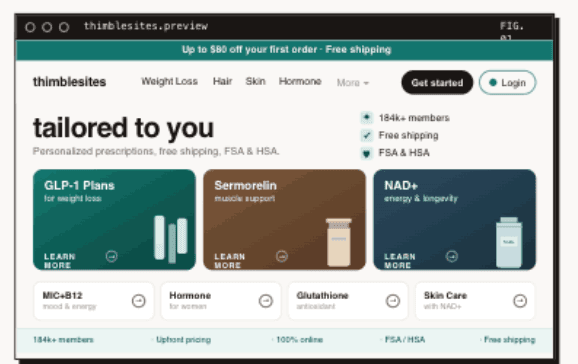
- 01.Patient visits your branded site and selects a treatment program (ED, hair loss, or both). Your site runs on Thimble Sites or embeds Thimble Cart checkout.
- 02.Intake questionnaire collects medical history, current medications, symptoms, and photos (for hair loss). Data auto-normalizes regardless of which form tool you use.
- 03.Provider review: The encounter is automatically dispatched to your provider network. Provider reviews intake, conducts async or video consultation, makes a clinical decision.
- 04.Prescription generated and routed to the correct pharmacy. Compounded ED chewables go to your compounding partner. Generic finasteride goes to retail pharmacy. Testosterone goes to a pharmacy licensed for Schedule III. All automatic.
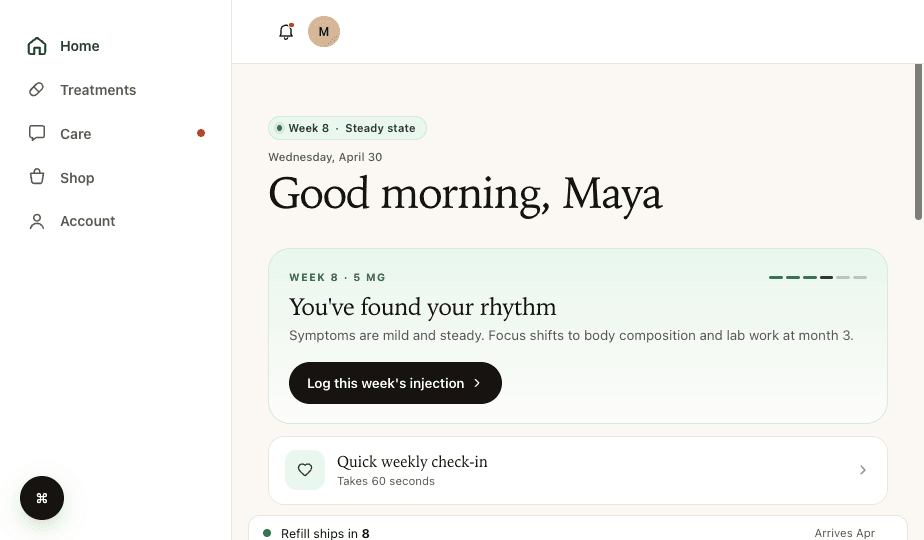
- 05.Patient portal activates: The patient gets a branded portal with treatment tracking, refill management, messaging, and subscription controls. They see your brand, not ours.
- 06.Refill automation: 30/60/90-day refill cycles managed automatically. Failed payments trigger recovery sequences. Provider check-ins scheduled based on clinical protocol. Lab reminders for TRT patients.
Competitive Positioning: How a New DTC Men's Health Brand Differentiates Against Hims
You cannot out-spend Hims on advertising. They spend over $600 million per year on marketing - roughly 46% of their revenue (per H&H 2024 10-K). But you can compete on dimensions where large-scale DTC brands are structurally weak:
- Clinical depth: Hims optimizes for volume. A smaller brand can offer more thorough consultations, longer provider relationships, and personalized protocols. Many men feel like they're getting a vending machine experience from Hims.
- Niche positioning: Focus on a specific audience (athletes, men over 50, men dealing with post-finasteride concerns) rather than trying to serve all men. Niche brands build stronger communities and higher LTV.
- Compounded formulations: Custom topical combinations and unique delivery formats (chewables, troches) that differ from Hims' standard offerings. Your compounding pharmacy partner is your product differentiation.
- Community and content: Build an audience through education-first content (YouTube, podcasts, newsletters) before spending on paid acquisition. Men's health content creators with trusted audiences can convert at 5-10x the rate of cold paid ads.
- Concierge experience: White-glove service with direct messaging to providers, rapid response times, and proactive check-ins. Charge a premium and compete on experience rather than price.
Unit Economics: What the Numbers Look Like
- Average order value: $35-120/month depending on product mix (ED only vs. ED + hair vs. comprehensive program with TRT)
- Cost of goods (medication + pharmacy): $5-25/month for generics; $15-40/month for compounded formulations
- Provider cost per encounter: $8-20 for async review; $25-50 for synchronous video (TRT)
- Platform infrastructure: Thimble Portal fees based on volume
- Customer acquisition cost: $80-300 depending on channel and vertical (ED is most competitive; hair loss and TRT have lower CAC)
- Average customer lifetime: 6-18 months (ED); 12-36 months (hair loss); 24-60 months (TRT)
- Gross margin after COGS and provider: 50-70% on ED; 40-60% on compounded products; 30-50% on TRT (higher clinical costs)
Timeline: From Idea to First Patient
- Week 1-2: Define your clinical protocol, brand positioning, and target product mix. Establish pharmacy partnerships (compounding + retail).
- Week 3-4: Configure your Thimble Portal instance. Set up intake flows, provider routing, pharmacy connections, and billing. Brand your portal and site.
- Week 5-6: Onboard your clinical team or connect your provider network. Run end-to-end test orders. Train your operations team on the admin dashboard.
- Week 7-8: Soft launch to an initial patient cohort. Monitor the full pipeline. Iterate on the patient experience based on real feedback.
- Month 3+: Scale acquisition. Add products (start with ED, expand to hair, then consider TRT). Build automation workflows for retention.
Eight weeks from decision to first patient. Not 12-18 months. Not $1-3 million in custom engineering. A branded men's health company running on proven infrastructure.
Frequently Asked Questions
- How much does it cost to launch a DTC men's health brand on white label telehealth?
- On white label men's health telehealth infrastructure, you can launch for a fraction of what custom-built companies spent. Your primary costs are platform fees, pharmacy setup, provider network onboarding, and initial marketing. Compare this to Hims ($500M+ in technology spend) or Ro (over $1 billion raised, including a $500M Series D in 2021). The infrastructure eliminates the engineering cost entirely.
- Can I prescribe testosterone via telehealth?
- Yes, under the DEA's Fourth Temporary Extension (effective January 1, 2026 through December 31, 2026). Testosterone is Schedule III, which requires synchronous video consultation (not async). The proposed permanent DEA rule (NPRM published January 17, 2025) has not been finalized. Thimble Portal's compliance infrastructure handles the Schedule III requirements automatically.
- Do I need my own compounding pharmacy?
- No. Thimble Portal connects to compounding pharmacy partners and handles prescription routing automatically. You define which products route to which pharmacy, and the system manages fulfillment tracking and patient notifications. You can also bring your own pharmacy relationships.
- How do I compete with Hims on marketing?
- You don't out-spend Hims. You out-niche them. Focus on a specific audience or clinical approach. Build community through content and education. Compete on provider relationships and clinical depth rather than price. Many men churn from Hims because the experience feels impersonal. A smaller brand with better engagement retains longer.
- What states can I start in?
- For ED and hair loss (non-controlled), you can start in nearly any state with asynchronous telehealth. For TRT (Schedule III), start with states that have clear telehealth frameworks for controlled substances (California, Florida, Texas are common starting points). Thimble Portal's state compliance engine helps you navigate the rules for each state.
Building a telehealth brand?
Thimble Hub gives you the checkout, intake, patient portal, and EHR-routing infrastructure so you can launch in weeks, not quarters. Modular, HIPAA-ready, no lock-in.