

The GLP-1 telehealth market is projected to be worth over $40 billion in North America by 2035. That growth isn't the problem. The problem is retention. Most GLP-1 programs can acquire patients; the ad channels are proven, the demand is enormous. What kills margin is patients who pay for month one and disappear before month three.
The patient portal is where retention lives or dies. Not your marketing site, not your checkout, not even your clinical quality (assuming it's competent). The portal is the product your patients interact with every week for months or years. If it's confusing, slow, or feels like an afterthought, patients leave. If it's clear, useful, and makes them feel taken care of, they stay.
We've built portals for GLP-1 programs processing thousands of patients. The patterns that drive retention are consistent and replicable. This post breaks down exactly what a high-retention GLP-1 portal looks like.
Why Most Patient Portals Fail for GLP-1
Traditional patient portals were designed for clinical documentation, not patient engagement. They're EHR-first: built to help clinicians manage records, with a patient-facing view tacked on as an afterthought. The result is a portal that feels like a medical records system, not a product.
GLP-1 patients don't need to browse their medical records. They need to know three things at any given moment: Where is my medication? When do I take my next dose? How do I get help if something feels wrong?
- EHR-based portals bury simple status updates behind clinical interfaces
- No clear medication tracking or shipment visibility
- Messaging feels like submitting a support ticket, not texting a care team
- Refill and subscription management requires calling or emailing
- Mobile experience is typically a responsive afterthought, not native-feeling
The 6 Features That Drive GLP-1 Portal Retention
1. Real-Time Order and Medication Tracking
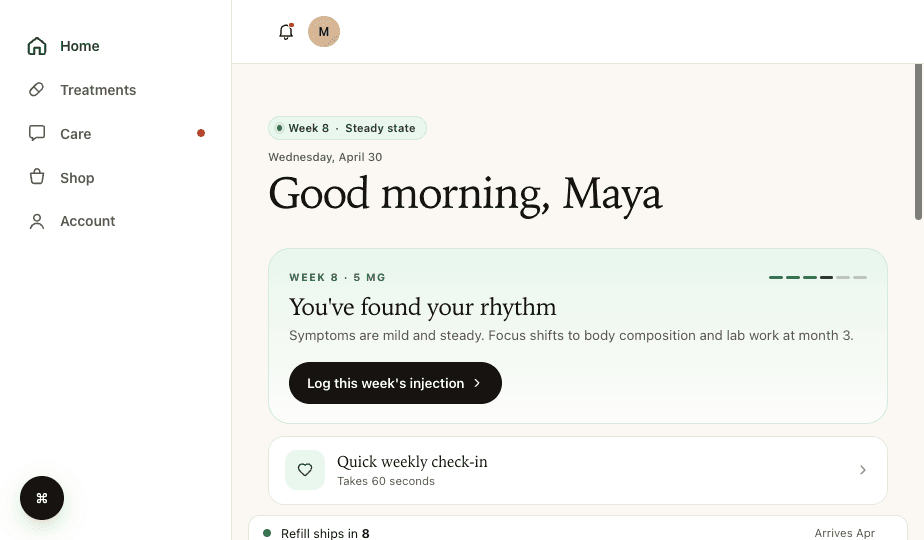
This is the single most important feature in a GLP-1 portal. Patients want to see exactly where they are in the treatment cycle: prescription submitted, pharmacy processing, shipped, delivered. The same visibility they get from Amazon for a package, they expect from their healthcare provider for their medication.
The portals with the highest engagement have a clear, visual status pipeline on the main dashboard. No clicking through menus. The patient logs in and immediately sees their current status. Based on our customer programs, this meaningfully reduces support tickets, since most patient inquiries are just 'where's my medication?'
2. Frictionless Messaging
GLP-1 patients have questions. Side effects, dosage concerns, injection technique, dietary guidance, weight plateaus. The portal needs to make it trivially easy to message the care team, and the care team needs to respond fast.
The messaging experience should feel like iMessage or WhatsApp, not a ticketing system. Threaded conversations, read receipts, quick replies, and notification via email or SMS when there's a new message. Patients who can easily reach their care team stay longer and have better outcomes.
3. Self-Service Refill and Subscription Management
Every friction point in the refill process is a churn risk. If patients need to call, email, or submit a form to get their next month's medication, some percentage will procrastinate, get frustrated, or simply forget. The best portals make refills one-tap and fully self-service.
- One-click refill requests with automatic provider review
- Subscription management: pause, skip a month, change plan, update payment, all self-service
- Automatic refill reminders before the current supply runs out
- Clear visibility into upcoming charges and billing history
4. Progress Tracking and Milestones
Weight loss is a journey, and patients who can see their progress are more likely to continue treatment. The portal should include simple tracking: weight log entries, progress charts over time, and milestone celebrations (first 10 lbs, halfway to goal, etc.).
This isn't a clinical requirement; it's a retention mechanism. Patients who see a downward trend on their weight chart are psychologically invested in continuing. Patients who don't track anything have no tangible proof that the treatment is working, even when it is.
5. Educational Content Delivery
GLP-1 patients, especially new ones, need guidance on diet, exercise, side effect management, and what to expect as treatment progresses. The portal is the ideal delivery mechanism for this content because you can time it to the patient's stage in treatment.
- Week 1: injection technique, storing medication, common side effects
- Week 2-4: dietary adjustments, hydration, managing nausea
- Month 2+: exercise recommendations, plateau strategies, long-term lifestyle changes
Timed educational content reduces support burden (patients find answers before they ask) and increases perceived value of the ongoing subscription.
6. Mobile-First, App-Quality Experience
The vast majority of GLP-1 portal usage happens on mobile. Patients check their medication status while waiting in line, message their care team from the couch, and log weight entries from their bathroom scale. The portal must feel like a native app, not a shrunken desktop site.
This means touch-optimized interfaces, fast load times, smart use of native device features (camera for photo uploads, push notifications for messages and status changes), and an experience that works perfectly on a 375px-wide screen.
Admin and Operations: The Other Side of the Portal
A patient portal is only as good as the admin workflows behind it. Your operations team needs tools to manage patient pipelines, respond to messages, process refills, handle escalations, and track key metrics, all without switching between five different systems.
- Patient pipeline view: See all patients by status: new, awaiting consult, active, paused, churned
- Unified inbox: All patient messages in one place with assignment and priority features
- Pharmacy routing dashboard: Track prescription status across fulfillment partners
- Subscription management: View, modify, or cancel subscriptions without logging into Stripe separately
- Analytics: Retention rates, time-to-first-fill, average response time, revenue per patient
Integration Architecture
A GLP-1 portal doesn't exist in isolation. It needs to connect to your provider network (OpenLoop, Wizlo, MDI, or in-house), your pharmacy fulfillment partner, your payment processor, and your CRM. The integration architecture matters because every broken handoff between systems creates a patient experience failure.
The portal should serve as the patient-facing layer that aggregates data from all these systems, presenting a unified experience regardless of how many backend services are involved. The patient doesn't care that their prescription went through DoseSpot to an Alto pharmacy; they care that their portal says 'shipped' with a tracking number.
The Bottom Line
In GLP-1 telehealth, the portal isn't a supporting feature; it's the core product that determines whether patients stay for 3 months or 18 months. The difference between strong and weak 90-day retention is the difference between a profitable program and one that's underwater on patient acquisition costs.
Build the portal patients want to open daily: clear medication status, easy messaging, self-service refills, visible progress, and an experience that feels like a modern app rather than a medical records viewer. Then back it with admin tools that let your operations team deliver on those patient expectations at scale.
Frequently Asked Questions
- Do GLP-1 patients need a mobile app or is a web portal enough?
- A well-built responsive web portal (progressive web app) is sufficient for most GLP-1 programs. Patients can add it to their home screen for an app-like experience without the cost and maintenance of native iOS/Android development. Native apps make sense at very high scale (50k+ patients) when push notifications and offline access become critical retention levers.
- How does a patient portal reduce churn in GLP-1 programs?
- Portal features directly address the top churn reasons: unclear medication status (order tracking), difficulty getting help (easy messaging), friction in refills (self-service subscription management), and feeling unsupported (progress tracking and timed educational content). Operators we've worked with see materially better 90-day retention compared to programs using basic EHR portals.
- Can a patient portal integrate with multiple provider networks?
- Yes. A well-architected portal acts as the patient-facing layer that can connect to any backend provider network via API. This means you can switch from OpenLoop to Wizlo, or use different networks for different clinical programs, without rebuilding your patient experience.
Building a telehealth brand?
Thimble Hub gives you the checkout, intake, patient portal, and EHR-routing infrastructure so you can launch in weeks, not quarters. Modular, HIPAA-ready, no lock-in.